Rooftop solar or plug-in solar?
Rooftop solar is a building project: a survey, scaffolding, an installer, an electrician and paperwork. A plug-in kit is closer to setting up a garden appliance. Both are worth having. They just do different jobs.
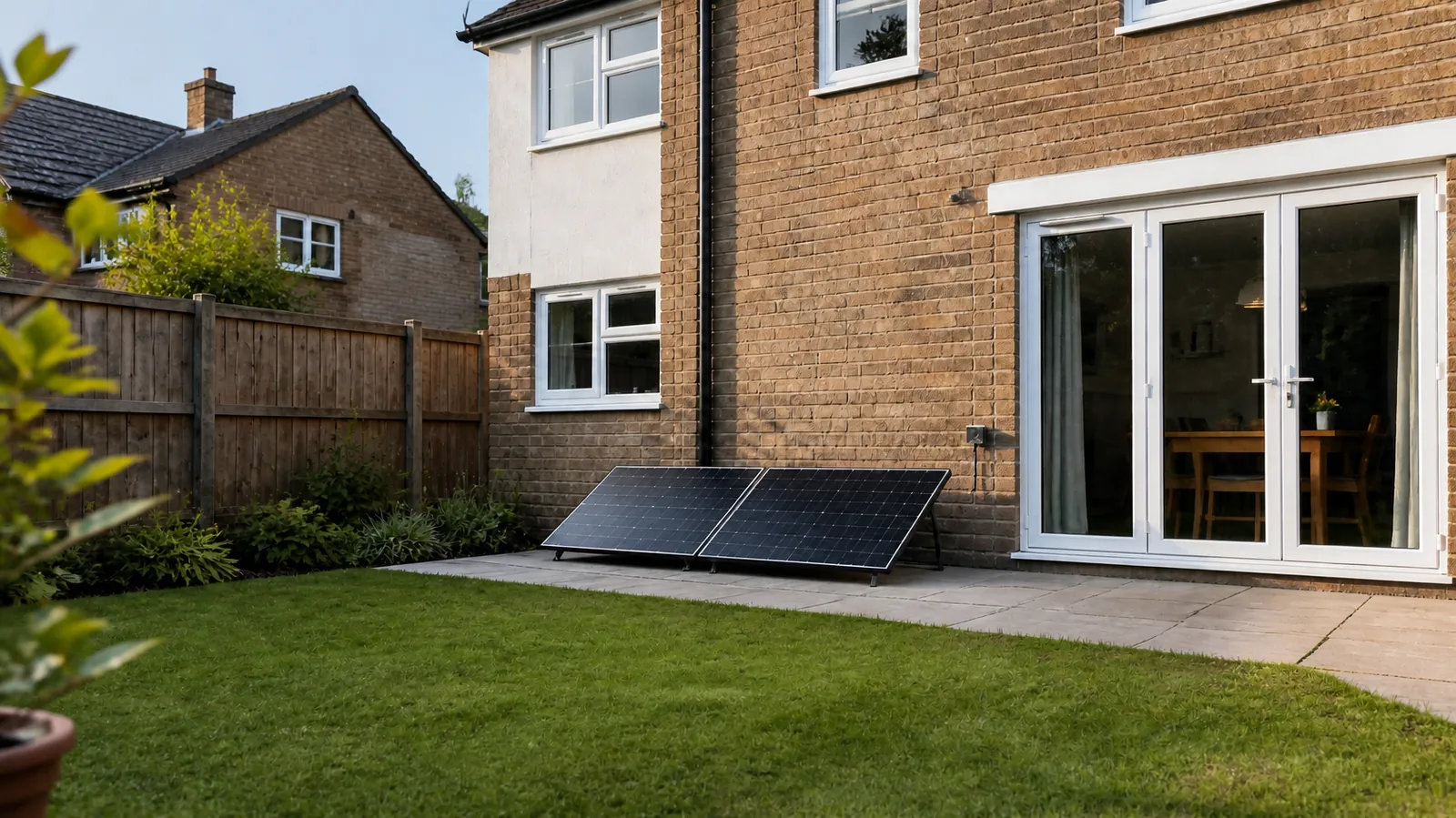
What each one involves
From first step to making electricity.
Fitted by an installer
Rooftop solar
8 steps
- 1Find installers and get quotes, usually with a survey of your roof
- 2Check the roof can take the load, and whether you need planning permission
- 3Agree the design: panels, inverter, maybe a battery
- 4Scaffolding goes up
- 5Panels and rails are fixed to the roof
- 6An electrician wires in the inverter, isolators and generation meter
- 7Your network operator is told (G98) or asked first for bigger systems (G99)
- 8You get an MCS certificate and apply for export payments
Usually weeks from first quote to switch-on, and several thousand pounds.
Set up by you
Plug-in solar
4 steps
- 1Unbox the kit and check nothing's damaged
- 2Set up the stand on level ground and add ballast, or fix the hybrid stand to a suitable wall
- 3Plug it straight into a weatherproof outdoor socket
- 4Connect the app and register the kit free at myplugin.solar
An afternoon with two people, once it's delivered. No scaffolding and no installer.
The plug-in steps follow the maker's quick set-up guides. Read the full manual that comes with the kit before you start.
Side by side
| Rooftop solar | Plug-in solar kit | |
|---|---|---|
| Who fits it | An installer, plus an electrician for the wiring | You, with a second person to lift |
| Where it goes | Your roof | Level ground, a patio or a suitable solid wall. Not a balcony |
| Size | Usually several kilowatts of panels | Up to 800W into your home (799VA), whatever the panels are rated |
| Wiring | New cabling, an inverter, isolators and a generation meter | A factory-fitted plug into a suitable outdoor socket |
| Scaffolding | Usually needed | Not needed |
| Paperwork | The installer deals with your network operator and MCS | You register the kit free at myplugin.solar |
| Time | Weeks: quotes, survey, booking, fitting | An afternoon after delivery |
| Cost | Several thousand pounds | Hundreds of pounds |
| VAT | 0% on installed panels until 31 March 2027 | Standard VAT. The 0% rate is only for installed systems |
| Export payments | Possible through the Smart Export Guarantee, with an MCS certificate | Don't count on them. The kit is for using power as it's made |
| Batteries | Can be added | Must not be used with a home battery |
| Renting | Rarely possible | Possible, with written permission from your landlord |
| Moving house | Stays with the house | Comes with you. Tell your network operator |
Rooftop details are typical and vary by installer. Get quotes for your own home.
Which suits you?
Rooftop solar suits you if…
you own the house, your roof faces roughly south and isn't shaded, you want to cover a big share of your electricity, and you're happy to pay more up front for more output over the years.
A plug-in kit suits you if…
you rent or can't use your roof, you'd rather not have scaffolding or a building job, you want to start small, or you might move. It tops up what you use during the day rather than replacing your supply.
Already have rooftop solar?
Ask your electricity network operator in writing before you add a plug-in kit. The plug-in rules allow one kit per household.
What a plug-in kit will and won't do
A plug-in kit sends up to 800W into your home while the sun's on the panels. Anything running at the time, like the fridge, router or washing machine, uses that first, so you buy less from the grid. It won't power your home in a power cut, and it switches off when the grid is off.
Our savings estimator shows a realistic range for your spot, and before you buy covers the socket, space and permission checks.
Common questions
Is a plug-in kit as good as rooftop solar?
Not for output. A rooftop system is usually several kilowatts, and a plug-in kit is capped at 800W into your home. But a plug-in kit costs far less, needs no installer or scaffolding, and can move with you.
Do I need an electrician for a plug-in kit?
Not to set it up. You do need a suitable weatherproof outdoor socket within reach of the kit's cable. If you don't have one, or you're not sure your fuse box has modern RCD protection, an electrician can fit or check it.
Do I have to tell anyone about a plug-in kit?
Yes. Register it free at myplugin.solar before you first use it. If you rent, own leasehold or live in a managed building, get written permission first, and tell your home insurer.
Can I get paid for the electricity a plug-in kit exports?
Don't count on it. Export payments through the Smart Export Guarantee usually need an MCS-certified installation, so plan on using the power as it's made.